PATACON

Constrained Motion Planning

PATACON

GPU-Parallel Tangent-Bundle RRT-Connect
for Constrained Motion Planning

Gahyun Oh1· Junho An1· Suhyun Jeon2· Suhan Park1,*
1 Department of Robotics, Kwangwoon University, Seoul, Republic of Korea
2 Department of Intelligence and Information, Graduate School of Convergence Science and Technology, Seoul National University, Republic of Korea
* Corresponding author

Real-time constrained replanning across simulated and physical whole-body tasks.

Overview

Tangent-Space Exploration × GPU Parallelism

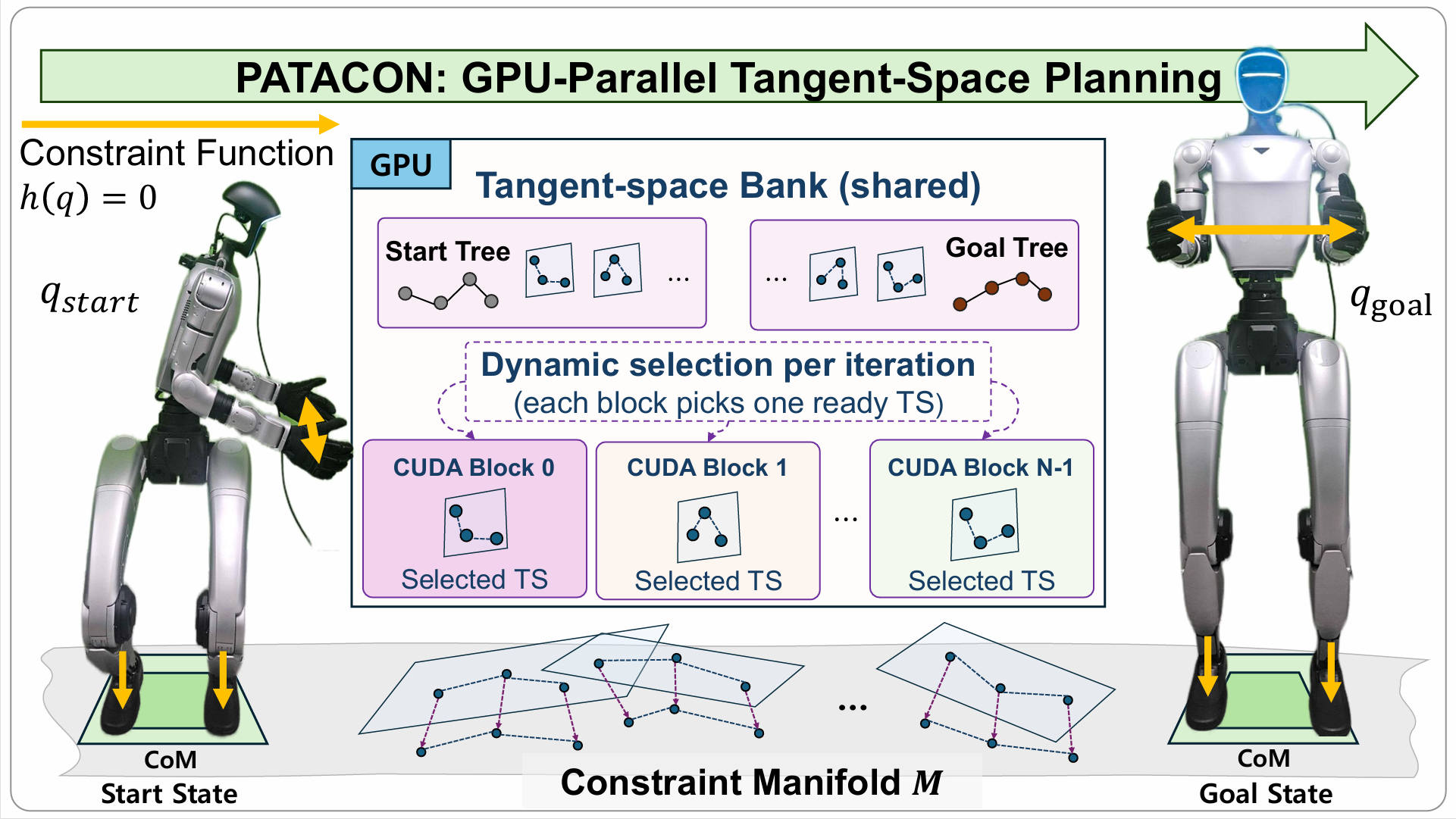
PATACON combines two complementary ideas for fast constrained motion planning: tangent-space-guided exploration and GPU-parallel expansion and validation. Instead of steering only in the ambient configuration space and relying on projection afterward, the planner uses local tangent spaces to generate directions that better follow the geometry of the constraint manifold.

During exploration, CUDA blocks dynamically select ready tangent spaces from tree-specific shared banks. Tangent-Guided Sampling (TGS) samples and searches locally within the selected tangent space, while Tangent-Guided Multi-Edge Projection (TGMP) reuses that exploration decision to generate several consecutive candidate edges.

These candidate edges are projected and validated concurrently on the GPU, and only the longest consecutively valid prefix is inserted into the tree before the planner attempts to connect toward the opposite tree. This couples geometry-aware exploration with massively parallel execution, reducing wasted off-manifold motion while amortizing tangent-space management over multiple edges.

PATACON overview with start and goal trees, shared tangent-space banks, and multiple CUDA blocks exploring local tangent spaces.
7–35 DoFbenchmark range
11.25×largest cpRRTC / PATACON latency ratio
100%PATACON success in reported benchmark regimes

Video

Motivation

Why PATACON?

Fast constrained planning is not only about accelerating projection. The planner must also avoid wasting computation on expansion directions that ignore the local geometry of the constraint manifold.

01

Why fast constrained planning?

Whole-body motion must be planned repeatedly under multiple constraints.

Bimanual and humanoid tasks operate in high-dimensional configuration spaces while maintaining task-dependent kinematic constraints, joint limits, and collision avoidance. When targets, obstacles, or task conditions change, the robot must replan repeatedly with low latency for responsive execution.

High Dimension Multiple Constraints Repeated Replanning
FFW-SG218 DoF · Bimanual + Axis + CoM
Unitree G135 DoF · Bimanual + Axis + Feet + CoM
02

Limitation of GPU acceleration

GPU parallelism makes projection faster, but steering remains unchanged.

Existing GPU planners can project and validate motion waypoints in parallel. However, the extension itself still steers toward samples in the ambient configuration space, without using the local geometry of the constraint manifold.

The computation is parallelized, but the exploration geometry is unchanged.

03

Limitation of ambient-space steering

Ambient-space steering can spend projection effort on poor candidates.

Because ambient-space samples ignore the manifold shape, candidate motions can deviate substantially from the feasible set. Projection may require a large correction, and the projected motion can make little useful progress along the manifold.

Ambient spaceIgnores manifold geometryLarge projection correctionLittle progress after projection
Tangent spaceUses local manifold geometryCandidates stay closer to the manifoldPromotes useful progress

Method

Explore locally. Validate in parallel.

PATACON combines geometry-aware sampling with speculative multi-edge expansion so the overhead of tangent-space management can be amortized over useful GPU-parallel work.

TGS

Tangent-Guided Sampling

Each CUDA block dynamically selects a ready tangent space from the bank of the current tree. A sample is generated inside that local tangent space, and the nearest-node search is restricted to nodes associated with the same tangent space.

Purpose: choose an expansion direction that reflects the local geometry of the constraint manifold.

Results

From 7-DoF manipulation to 35-DoF whole-body planning.

The benchmark suite increases both configuration-space dimension and constraint restrictiveness. The clips below use the same task families shown in the presentation.

Franka Panda

7 DoF · OR (2D)

Dual Franka

14 DoF · BK (6D)

Dual Franka + axis

14 DoF · BK + OR (8D)

FFW-SG2 · fixed

15 DoF · BK (6D)

FFW-SG2 + axis

15 DoF · BK + OR (8D)

FFW-SG2 · mobile

18 DoF · BK + OR / CoM

Unitree G1

35 DoF · BK + FT / CoM

Unitree G1 + axis

35 DoF · BK + OR + FT / CoM

Dynamic replanning

Planning latency matters when the world moves.

In the presented Unitree G1 dynamic-obstacle comparison, the two planners are shown side by side under the same type of replanning scenario.

cpRRTC

Replanning failure

3.1 Hz

Collision occurs before a successful replan is available.

PATACON

Successful replanning

4.01 Hz

The replanned motion avoids the moving obstacle in the demonstrated sequence.

AO-PATACON

Fast first solutions leave time for refinement.

AO-PATACON restarts the search with a tighter cost bound whenever a lower-cost feasible solution is found, progressively improving the best-so-far path within the remaining budget.

Initial solutioncost 10.59
After 5 scost 5.69225

Real-world demonstrations

Whole-Body Constrained Motion on a Real Robot

Three real-robot clips from the presentation, covering different combinations of bimanual, axis, fixed-foot, and center-of-mass constraints.

G1 · Bimanual + Feet + CoM

G1 · Bimanual + Axis + Feet + CoM

FFW-SG2 · Bimanual + Axis + CoM

Citation

PATACON

Update the venue and publication metadata when the final paper information is available.

@inproceedings{patacon2027,
  title  = {PATACON: GPU-Parallel Tangent-Bundle RRT-Connect for Constrained Motion Planning},
  author = {Gahyun Oh and Junho An and Suhyun Jeon and Suhan Park},
  year   = {2027}
}